Listed vs Unlisted Company: Which Is Right for You?
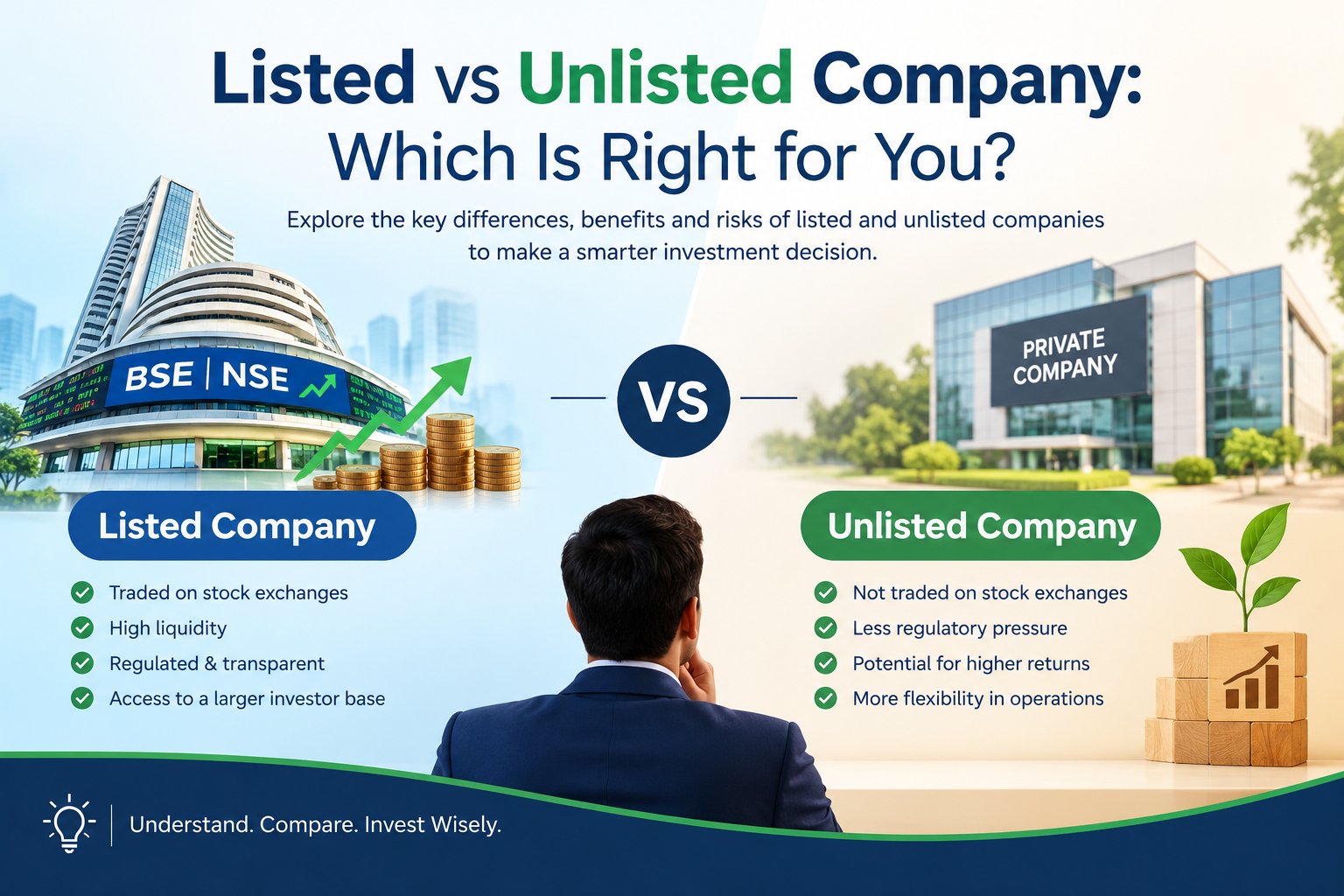
Every company in India falls into one of two groups: listed or unlisted. The label depends on one simple thing: can the public buy and sell its shares on a stock exchange? That single fact shapes how a company raises money, who owns it, how much paperwork it handles, and even how its shareholders are taxed.
If you are a founder deciding how to structure your business, or an investor weighing where to put your money, this guide breaks down the differences in plain language.
What Is a Listed Company?
A listed company is one whose securities are admitted for trading on a recognised stock exchange such as the National Stock Exchange (NSE) or the Bombay Stock Exchange (BSE). Anyone with a demat account can buy or sell its shares on any trading day. Reliance Industries and TCS are familiar examples.
The Companies Act, 2013 (Section 2(52)) treats a company as listed once any of its securities are listed on a recognised exchange. To get there, a company must satisfy SEBI and exchange eligibility conditions, including track record, net worth, public shareholding and disclosure standards under the SEBI (ICDR) Regulations.
What defines a listed company:
- Shares trade openly, and the price moves with demand, supply and market sentiment.
- Ownership is spread across retail investors, mutual funds, institutions, foreign portfolio investors and HNIs.
- Financial results must be published every quarter, along with annual reports.
- Independent directors and an audit committee are compulsory.
- Insider trading rules and SEBI’s continuous disclosure norms (SEBI LODR, 2015) apply at all times.
What Is an Unlisted Company?
An unlisted company is one whose shares are not traded on any stock exchange. It can be a private limited company, or even a public company that has simply never gone for listing. Shares are held by founders, family, angel investors, venture capital or private equity funds, and employees through ESOPs.
Unlisted companies are mainly governed by the Companies Act, 2013 and tax laws. SEBI’s listing regulations do not apply unless the company decides to raise money from the public. That means lower compliance cost, fewer disclosures and more freedom for the promoters to run the business their way.
Most startups in India begin life as unlisted companies. Many well-funded, high-profile businesses also stay unlisted for years before approaching the market.
Listed vs Unlisted Company: Side-by-Side Comparison
| Basis | Listed Company | Unlisted Company |
|---|---|---|
| Meaning | Shares traded on NSE/BSE | Shares not traded on any exchange |
| Governing rules | Companies Act + SEBI regulations | Mainly Companies Act and tax laws |
| Shareholders | Public, institutions, FPIs, HNIs | Promoters, angels, VC/PE funds, employees |
| Selling shares | Instantly through the exchange | Private deal, share transfer agreement and board approval |
| Liquidity | High | Low; finding a buyer takes time |
| Price discovery | Market-driven, changes daily | Negotiated or based on a professional valuation |
| Disclosures | Quarterly and annual, public | Annual filings with the ROC |
| Raising capital | IPO, FPO, QIP, rights issue | Private placement, angel, VC, PE |
| Governance burden | Heavy | Moderate to light |
| Compliance cost | High | Comparatively low |
| Public visibility | Very high | Limited |
How Shareholders Are Taxed
Tax is where the listed/unlisted gap hits an investor’s pocket most directly. Based on the rules in force after Budget 2024, the broad picture is:
| Tax point | Listed shares | Unlisted shares |
|---|---|---|
| Counts as long-term after | 12 months | 24 months |
| Long-term capital gains | 12.5% on gains above ₹1.25 lakh a year | 12.5% with no exemption limit |
| Short-term capital gains | 20% | As per your income tax slab |
| Indexation | Not available | Not available |
| Securities Transaction Tax | Applicable | Not applicable |
Tax rates and thresholds change with each Budget, so please confirm the latest position with a chartered accountant before acting on it.
Can You Invest in an Unlisted Company?
Yes, it is perfectly legal. The common routes are:
- Pre-IPO purchases: buying shares from existing shareholders before a company goes public.
- ESOPs: employees receive stock options that become shares after vesting.
- Angel or private equity investment: putting money directly into a startup through a formal investment agreement.
The trade-off is risk. Prices are not publicly visible, exits can take years, and valuations often reflect the last funding round rather than present reality. Always do proper due diligence: check financials, the shareholders’ agreement, cap table and any transfer restrictions before you invest.
How an Unlisted Company Becomes Listed
The usual path is an Initial Public Offering (IPO). In outline:
- Convert to a public limited company if you are currently private.
- Appoint merchant bankers and prepare a Draft Red Herring Prospectus (DRHP).
- File the DRHP with SEBI and respond to its observations.
- File the final Red Herring Prospectus and open the issue for public subscription.
- Allot shares to investors and get listed on NSE and/or BSE.
Most companies start preparing well in advance, often a year or two. That period goes into cleaning up financials, building a board with independent directors, setting up committees and tightening compliance.
Which Is Better for Your Business?
Neither is better in every case. It depends on your stage and goals.
Staying unlisted makes sense when:
- You are early-stage and need to move fast with minimal compliance.
- You want to keep full control over decisions.
- Venture capital or private funding is enough for your growth plans.
- The cost of listing outweighs the capital you need.
Going for a listing makes sense when:
- You need large capital that private investors cannot easily provide.
- Early investors and founders want a clean exit route.
- Public credibility and brand visibility are strategic priorities.
- You have steady profits and meet SEBI’s eligibility norms.
Start the Right Way with Register Your Startup
Whether you want to launch a Private Limited Company today or build towards a public listing tomorrow, the structure you choose in the beginning matters. Register Your Startup helps founders pick the right entity type, complete incorporation smoothly and stay on top of ROC and MCA compliances, so your paperwork never slows your growth.
Ready to register your company? Talk to the Register Your Startup team today.
Frequently Asked Questions
What is the main difference between a listed and an unlisted company?
A listed company’s shares trade on a stock exchange like NSE or BSE and it must follow SEBI rules. An unlisted company’s shares do not trade publicly, it is governed mainly by the Companies Act, and its shares are harder to sell.
Is a private limited company listed or unlisted?
A private limited company cannot offer shares to the public, so it is unlisted. It must first convert into a public company before it can go for an IPO.
Do unlisted companies need to file financial statements?
Yes. They file annual audited financial statements and returns with the Registrar of Companies, but they are not required to publish quarterly results.
Are unlisted shares riskier than listed shares?
Generally yes, because of lower liquidity, less transparency and subjective valuations. That is why careful due diligence is essential.
Can a listed company become unlisted?
Yes, through delisting, which is carried out under SEBI’s delisting regulations and requires the necessary approvals.